OpenMed
🚀 Description
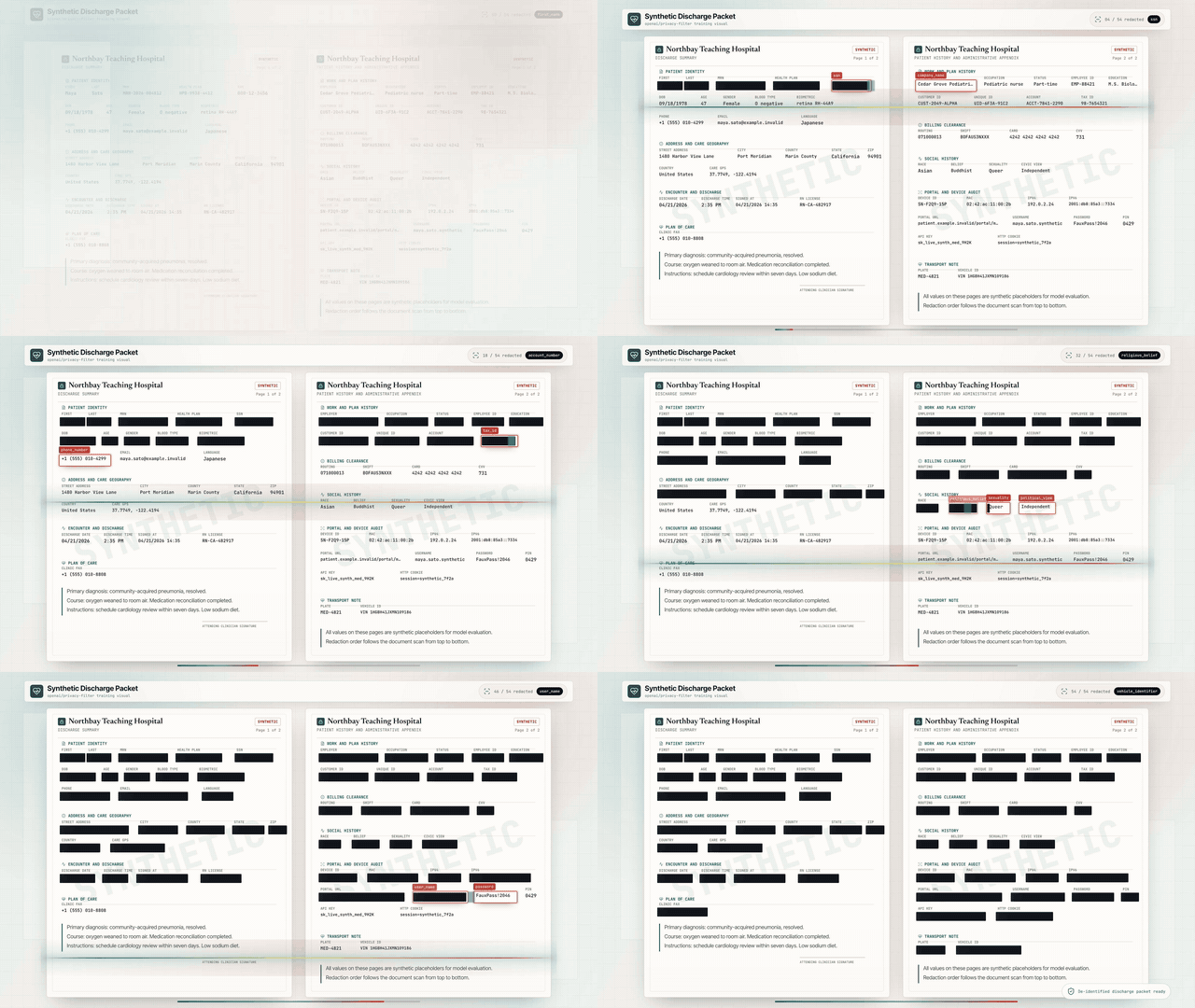
maziyarpanahi/openmed — local-first healthcare AI that never leaves the device. Clinical NER (diseases, drugs, anatomy, genes) and HIPAA PII de-identification running 100% on your own hardware: pip install "openmed[hf]", one function call, no API key, no network call, no patient data leaving the network. 1,000+ curated medical models · 247 PII checkpoints · 15 languages · Apache-2.0.
Runs everywhere the data lives: CPU/CUDA PyTorch, Apple Silicon via MLX (24–33× faster than CPU PyTorch for the Privacy Filter), native iOS/macOS apps through OpenMedKit (Swift), a Dockerized FastAPI REST service, and in-browser WebGPU token classification via Transformers.js ONNX export.
🧩 Features
- One-liner NER —
analyze_text(text, model_name="disease_detection_superclinical")→ typed entities with confidence; registry of specialist models (disease, pharma, anatomy, gene, PII) 109M–434M params. - HIPAA-aware de-identification — all 18 Safe Harbor identifiers;
deidentify()methods:mask,replace(Faker-backed, locale-aware, format-preserving fakes incl. CPF/BSN/Aadhaar/PESEL-style national IDs),hash,shift_dates. Policy profiles for HIPAA/GDPR/research with signed audit reports. - Smart entity merging — keeps
01/15/1970one DATE instead of tokenizer fragments. - Privacy Filter family — three weight sets on the OpenAI Privacy Filter architecture (gpt-oss-style sparse-MoE): OpenAI baseline, NVIDIA Nemotron-PII fine-tune, OpenMed multilingual; same
extract_pii()API, MLX + 8-bit variants; MLX names auto-fall-back to PyTorch checkpoints on non-Apple hosts. - Multilingual PII — 15 language codes (ar, de, en, es, fr, he, hi, id, it, ja, nl, pt, te, th, tr). No Polish.
- Production REST service — warm pools, dynamic batching, request coalescing, rate limits,
/livez/readyz, model unload/keep-alive; batch mode up to 3.3× CPU throughput. - Air-gapped mode — point
model_idat a local directory; never contacts Hugging Face Hub. - FHIR + HL7 v2 interop docs — de-identification wired into healthcare data formats.
Reasoning for
The strongest example yet in this vault of the local-first, data-never-leaves pattern applied to a regulated domain — the same argument Voicebox makes for voice and LibreChat for chat, but with real compliance stakes (its security policy treats a redaction bypass as a vulnerability). Two practical angles for me: (1) the PII de-identification pipeline is domain-generic — 247 checkpoints, Faker-backed format-preserving replacement, and policy profiles are directly relevant to any client project that must scrub personal data before sending text to a cloud LLM; (2) as a document pipeline it composes with MinerU / Unlimited-OCR — scan/parse first, then extract entities and redact on-device. Polish absence limits direct PLSoft use for now.
Alternatives considered
- Cloud medical APIs (AWS Comprehend Medical, Google Healthcare NLP) — per-call pricing, PHI sent to the vendor; OpenMed’s entire pitch is the inverse.
- Microsoft Presidio — general-purpose open-source PII de-identification, regex+NER hybrid; OpenMed is transformer-based, medical-specialized, with far more checkpoints.
- spaCy/scispaCy — lighter biomedical NER, weaker on de-identification tooling and deployment story.
🔗 Links
- Repo: https://github.com/maziyarpanahi/openmed
- Docs: https://openmed.life/docs/
- Model registry: https://openmed.life/docs/model-registry
- Paper (OpenMed NER): https://arxiv.org/abs/2508.01630
🔗 Related notes
- MinerU · Unlimited-OCR — upstream document parsing; combined = scan → structure → de-identify, all local
- Voicebox · LibreChat — the local-first pattern in other modalities
- AI Agent Security — the data-leaves-the-network risk class this eliminates
Template: tool