Hugging Bay
🚀 Description
Hugging Bay (huggingbay.xyz) — pitched as the “Pirate Bay for open LLMs”: a verified artifact registry for downloading open model weights via torrents and hosted mirrors. Per the announcement, every artifact is checked for provenance and license clarity before indexing, and a semantic rerank search answers natural-language queries like “best small commercial embedding model for RAG”.
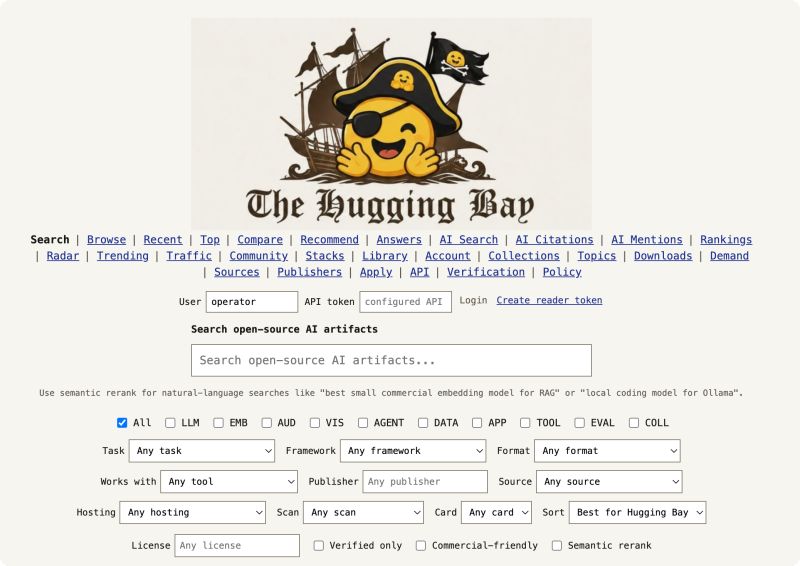
Positioning vs Hugging Face (from the post’s addendum): HF is the centralized ecosystem for hosting and collaboration; Hugging Bay is a narrower, decentralized distribution layer — a hedge for when a centralized platform faces legal or political pressure, takedowns, or bandwidth limits.
🧩 Features (claimed)
- Torrent + mirror distribution of open model weights
- Provenance and license verification before indexing
- Category filters: LLMs, embeddings, visual, audio, agents, datasets, apps, tools, evals
- Semantic rerank over natural-language search queries
⚠️ Verification status
Re-verified 2026-07-07 (site fetch + web search). Findings:
- Site is live — the launch-day 502s from the LinkedIn thread are resolved. Self-description: “verified open-source AI artifact registry with broad catalog metadata, source provenance, license clarity, community trust signals” and selective hosted mirrors. Agent-friendly by design: robots.txt AI guidance, OpenAPI docs, agent manifest, plus a browser-extension overlay for Hugging Face.
- What “verified” actually means — catalog metadata + source provenance + license clarity + community trust signals; hosted mirrors ship file hashes. A “needs first review” ranking implies human/community review. No cryptographic signing, no stated audit process — hashes prove integrity of their mirror, not that the weights match the original publisher’s.
- Operator still anonymous — no organization or individual identified anywhere on the site. The core trust concern from the launch thread stands.
- “Hugging Bay” is also a meme-turned-movement — the viral post spawned at least two independent open-source clones: DrMaxis/the-hugging-bay (Laravel/Vue torrent index PoC, MIT, ~55 stars, no file hosting) and nagaoo0/hugging-bay.org (Go + Next.js + Meilisearch + opentracker, SHA-256/512 + BLAKE3 verification, built-in tracker). Neither is confirmed as huggingbay.xyz’s codebase.
Bottom line: functional and more substantial than a meme site, but anonymous operator + no signature chain means the original advice holds — use it for discovery/resilience, pull weights from the original publisher when it matters.
Reasoning for
Interesting as a distribution-resilience signal, not (yet) as a tool I’d use: open-weight availability currently has a single point of failure in Hugging Face, and torrent-based mirroring is the obvious decentralization move. Relevant to any self-hosted inference setup (NemoClaw) that depends on pulling weights. Verified live (2026-07-07) and agent-friendly (OpenAPI + agent manifest), but with an anonymous operator and no signature chain: use for discovery and resilience, download weights from the original publisher when integrity matters.
Alternatives considered
- Hugging Face — the default source; centralized but with real provenance (publisher accounts, safetensors scanning).
- Direct publisher releases (GitHub Releases, vendor CDNs) — the trust-maximal path.
- Academic torrents / IPFS mirrors — prior art for the same decentralization idea, without the catalog layer.
🔗 Links
- Site: https://huggingbay.xyz
- Source post: https://www.linkedin.com/feed/update/urn:li:activity:7479781015528386560/
🔗 Related notes
- NemoClaw — self-hosted inference; the consumer side of open-weight distribution
- OpenMed — example of a project whose models pull from the HF Hub (with an air-gapped local fallback)
Template: tool