Graft
Every coding-agent task starts blind: grep a term, open a file, follow an import, back out, try again. Graft’s bet is that this rediscovery is pure, repeated, discarded overhead — so it builds the understanding once and writes it into the repo as a folder of linked markdown files, one node per system, API, or concept. The agent reads those files the way it reads any other file.
Repo: trailhq/Graft · npm @nanonets/graft · dev repo NanoNets/context-graph-engine.
All numbers below are vendor-reported (project README). The SWE-bench arm at least uses the official
swebench4.1.0 grader and official Verified images, which is a stronger claim than a self-judged sweep — but it is 50 instances, not the full 500, and both arms were run by the vendor.
Links
🗒️ Description
Two artifacts, two cost profiles — this is the part worth internalizing:
- The structural graph —
graft buildruns pure tree-sitter. Every function, class, and call edge lands ingraft/.graph/wiring.jsonplus a per-file wiring card mirroring the source tree. No model, no API key, no network.graft ask,grep,callers,skeleton,map,blastandcheckall read this and never call an LLM. - The concept graph —
graft build --deepadds the LLM layer, in two passes: summarize each file, then group those summaries into a curated set of nodes (subsystems, key files, concepts) with typed links. Graft picks the level of detail rather than emitting one node per file, so a big repo becomes a few dozen readable nodes. Your provider, your key, your model.
graft/ is git-ignored on purpose — a regenerable local cache like node_modules, not a committed artifact. What you commit is the small wiring graft init drops into .claude/ and friends; each teammate runs graft build to generate their own.
What’s in a node. Most code maps stop at an address — this thing lives in that file, on that line — which tells an agent where to look, not what it will find, so it still has to open the source. A Graft node carries the meaning inline: a plain-English summary, the crux (the handful of lines that actually carry the logic — the guard, the skip condition, the state change), the sources each tracked by content hash, typed links as [[wikilinks]] (depends_on, part_of, uses, implements, produces), and a notes section below the generated block that survives regeneration. Three depths in one file: what, how, and where to go for the rest.
The crux is stored as the code text, not a line range — deliberately. Line numbers drift when unrelated code above them shifts; the lines that matter do not.
🧩 Features
- Freshness without an index to babysit. Every query stats the tree against the last build’s fingerprint (~3 ms) and rebuilds only what moved, so answers describe the working tree right now — uncommitted, unstaged and staged edits all look the same to Graft. The refresh is structural and
$0; it never calls the LLM. Disable per-command with--no-refreshor globally withGRAFT_NO_REFRESH=1. - 23 languages, three tiers. Full-fidelity hand-written extractors with scope-aware cross-file call/import resolution (TS/JS incl. JSX/TSX, Python, Go, Java, Kotlin, PHP, Swift, R); broad generic tree-sitter extraction (Rust, C, C++, C#, Ruby, Scala, Elixir, Solidity, OCaml, Zig, Dart, Clojure, Nix, Lua); and opt-in compiler-grade edges via
graft build --lspwhen rust-analyzer / clangd / gopls / pyright / typescript-language-server is onPATH. - Content-hash caching everywhere — LLM passes and tree-sitter parse alike. On the Graft repo itself (124 files): 0.74 s cold, 0.18 s after one edited file. That cheapness is what makes the per-query refresh affordable.
- Six MCP tools —
graft_find_code(question → ranked nodes with file:line and source inlined),graft_file_api(every signature in a file, no bodies, ~1/10th the tokens),graft_trace_calls(blast radius, N levels, either direction),graft_find_all(regex, grouped by enclosing symbol, ranked by coupling),graft_repo_map,graft_check_freshness. graft blast— blast radius of a diff: what depends on the lines a change touched.--base origin/main --format markdownproduces a PR comment,--namelabels the areas with one cached LLM call, and git history names who to tag. This is the feature I have not seen elsewhere in this lane.- Deep Claude Code wiring —
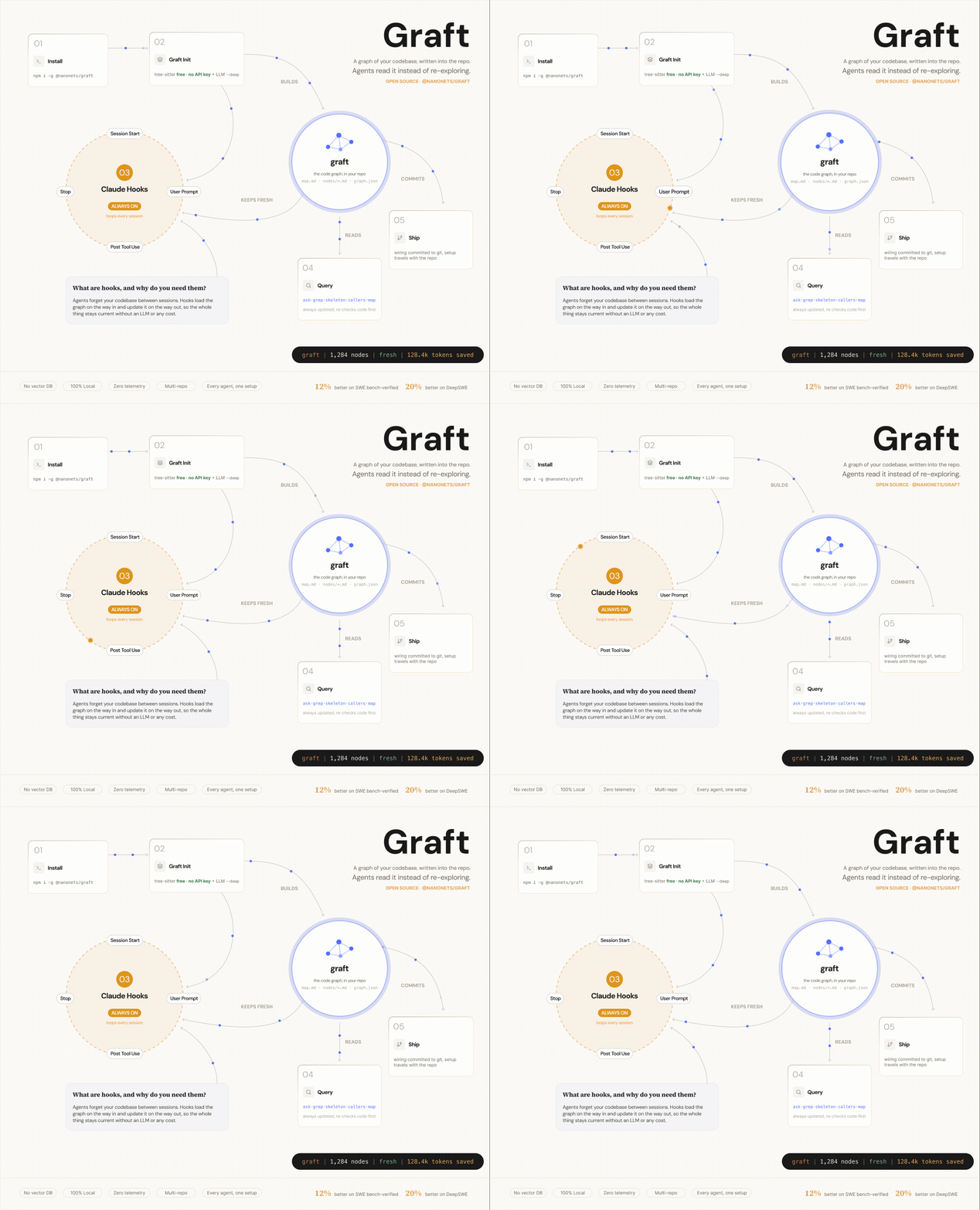
graft initwrites.claude/skills/graft/SKILL.md(it owns that file and never touches yourCLAUDE.md), a live statusline showing graph size / % enriched /⚠ N stale, post-edit hooks for blast-radius warnings and$0re-sync, and the MCP server into the project’s.mcp.json. It merges into.claude/settings.jsonrather than clobbering it, and leaves a non-GraftstatusLinealone. - Nine agents from one command —
agents(the sharedAGENTS.mdthat Codex/OpenCode read),cursor,gemini,grok,copilot,kiro,windsurf,adal,claude. Marker-fenced sections in shared files, wholly-owned files where the agent uses one. - Monorepo / submodule / multi-repo aware — per-scope ranking then fusion, so the biggest sub-project cannot drown a small one;
--follow-submodulesand--follow-nested-repos(independent flags, persisted in.graft/config.json) for gitlinked and non-gitlinked nested clones; a folder of separate repos auto-splits with a federatinggraft/workspace.json. graft viz— prebuilt interactive viewer, no dev server. Context tab (architecture graph), Code tab (per-symbol wiring), Outline tab (file→class→method tree). Select a node and edges take direction: amber = depends on, teal = depended on by, verb written on the edge; tree-sitter edges solid, LLM-inferred dashed.--export site/writes one self-containedindex.htmlfor CI or Pages.graft uninstall— a real inverse ofinit, including the out-of-repo writes. Rarer than it should be.
📊 The benchmarks
Two harnesses making two different claims.
Controlled sweep — 162 runs, two repos, 3 trials, Claude Sonnet 5 with identical file tools, Opus 4.8 judge with a required-keyword floor, cache-aware costing:
| Metric (mean/task) | Cold Claude Code | With Graft |
|---|---|---|
| Cost | $0.0429 | $0.0292 (−32%) |
| Tokens | 8,070 | 4,650 (−42%) |
| Tool calls | 4.2 | 2.3 (−46%) |
| Latency | 39.8 s | 15.8 s (−60%) |
| Correctness | 93% | 93% (equal) |
SWE-bench Verified, 50 instances, Claude Sonnet 5 both arms, official grader:
| Cold | With Graft | |
|---|---|---|
| Resolved | 27 / 50 (54%) | 33 / 50 (66%) |
| Tokens | 142.0 M | 109.4 M (−23%) |
| Wall-clock | 13,094 s | 8,922 s (−32%) |
The correctness wins have a consistent shape: the baseline patches one file and misses its siblings. On django-11532 it patched 1 of the 5 files the fix needs and broke 18 passing tests; on django-16263, 1 of 4. That is exactly the failure mode a call/dependency graph should fix, which makes the result more believable than the headline percentage alone.
Push vs pull is the interesting finding. Injecting a graft ask --source bundle up front (push) buys the speed. Exposing graft_find_code / graft_file_api as tools and paying for context only when the agent asks (pull) gave up most of the speed but pushed correctness to 98%, +5 points over cold — the strongest single result in their sweep. Push when speed is what you need; pull when being right matters more.
Separately they ran 15 tasks each on popular OSS repos — 10 developer questions plus 5 real merged PRs re-implemented from base commit and scored against the files the maintainers actually touched. On PocketBase (Go, ~350 files): cost $13.91 → $11.02 (−21%), wall-clock −14%, and 5/5 PRs reproduced touching the same files. The gap was widest on cross-file synthesis — “how does auth work across OAuth2 providers” fell from $2.19 to $0.84.
Download or use
npm install -g @nanonets/graft   # once
graft init                       # pick agents, build the graph, wire it in
graft init --dry-run lists every file it would touch before writing anything; graft init --agents claude skips the prompt. With no TTY (CI, Dockerfile, piped shell) it writes nothing and prints the command to run instead — pass --agents or --yes to make a scripted run explicit. npx @nanonets/graft init works without the global install.
⚠️ Read this before running init: selecting the agents host also writes to user-level Codex config when ~/.codex/ exists — config.toml (MCP server registration), hooks/graft/graft-hooks.cjs, and a PostToolUse entry in hooks.json. Those apply to every repo you open with Codex, not just this one. The picker labels them machine-wide and --no-global skips them.
Telemetry: one batched usage ping with buckets and fixed labels only (never code, paths, repo names, symbols, queries, or error messages), plus a daily npm version check. graft telemetry debug prints exactly what would be sent; disable with graft telemetry disable, DO_NOT_TRACK=1, or the checkbox in init. Off in CI and in builds from source.
Reasoning for
This is the strongest entry yet in the lane Structural Retrieval for Code maps out, and it differs from its neighbours on one axis that matters to me: the graph is markdown files the agent just reads. No database, no daemon, no embedding index, no server. Codebase Memory MCP answers in <1 ms from a SQLite graph; Serena and MCP Language Server hold a live language server; Graft’s artifact is inert text with [[wikilinks]] — the same shape as this Brain vault’s own progressive-disclosure indexes. If the MCP layer breaks, cat graft/whatever.md still works. That degradation path is worth a lot.
Concretely useful to me:
- Qamera AI and Brain’s own harness — the repos where Claude Code sessions burn the most context re-grepping the same modules. The
$0tree-sitter tier means I can trygraft build+graft askbefore committing to any LLM spend at all. graft blast --base origin/main— a PR comment naming the areas a change can reach, plus who to tag from git history. That is a review-workflow feature, not a retrieval feature, and none of the alternatives here have it.- The pull-over-push result — a transferable lesson beyond this tool: front-loading context is a speed optimization that can cost correctness versus letting the agent pull what it decides it needs. Files under Context Engineering and Progressive Disclosure.
Caveats before I trust it in a real workflow. Every number is vendor-run; the SWE-bench arm is 50 of 500 instances. The crux — the feature that most distinguishes a Graft node from an address-only code map — ships per-symbol in the code graph today but is not yet inlined into the markdown nodes, so the README describes a node richer than the one currently written. And init writes to agent config files, hooks, and (for Codex) machine-wide paths: run --dry-run first, same audit discipline I applied to Codebase Memory MCP.
Alternatives considered
- Codebase Memory MCP — closest functional sibling: persistent code knowledge graph over MCP, tree-sitter + hybrid LSP, single C binary, <1 ms queries. Binary+SQLite artifact vs Graft’s readable markdown; no
blast-style diff radius, but broader language coverage (158) and semantic search. - Serena · MCP Language Server — the LSP lane: live language-server symbol resolution, ground-truth accurate, no persisted artifact and no concept-level summaries. Graft’s opt-in
--lsptier borrows from this lane rather than competing with it. - Graphify — Claude Code skill producing a clustered knowledge graph from code/docs/images. Graph-as-skill vs Graft’s graph-as-files-plus-MCP.
- Understand Anything — Tree-sitter+LLM multi-agent pipeline building an explorable knowledge graph; aimed at human onboarding and exploration more than at cutting an agent’s token bill.
- RepoGraph — the published research version of this idea (ICLR 2025): tree-sitter def/ref graph retrieved via k-hop ego-graphs, +32.8% across four SWE agents. Graft is roughly this plus an LLM summarization layer plus agent wiring.
- GrepRAG — the opposing bet: no index at all, let the LLM generate ~10 ripgrep commands and re-rank. Index-free and ~1/35th the latency. Graft’s own
graft grepis a concession to the same insight — exhaustive regex for the tasks where a ranked top-N is not enough. - Plain grep/read — the cold baseline both benchmark arms measure against.
📖 Further reading
- trailhq/Graft — README, TELEMETRY.md, .env.example, CREDITS.md
- Structural Retrieval for Code — where this sits among the LSP / SCIP / repo-map / grep lanes, and when each wins
- Token Optimization for Claude Code — the same goal from the cost side; Graft belongs in that roster
- Context Engineering · Progressive Disclosure — the push-vs-pull result generalizes past code retrieval
Template: tool