Progressive Disclosure
🚀 Core principle
Show what exists and its retrieval cost first. Let the agent decide what to fetch based on relevance and need.
Information architecture pattern that reveals complexity gradually instead of all at once. The default approach for Context Engineering in agent systems.
🎨 The pattern at a glance
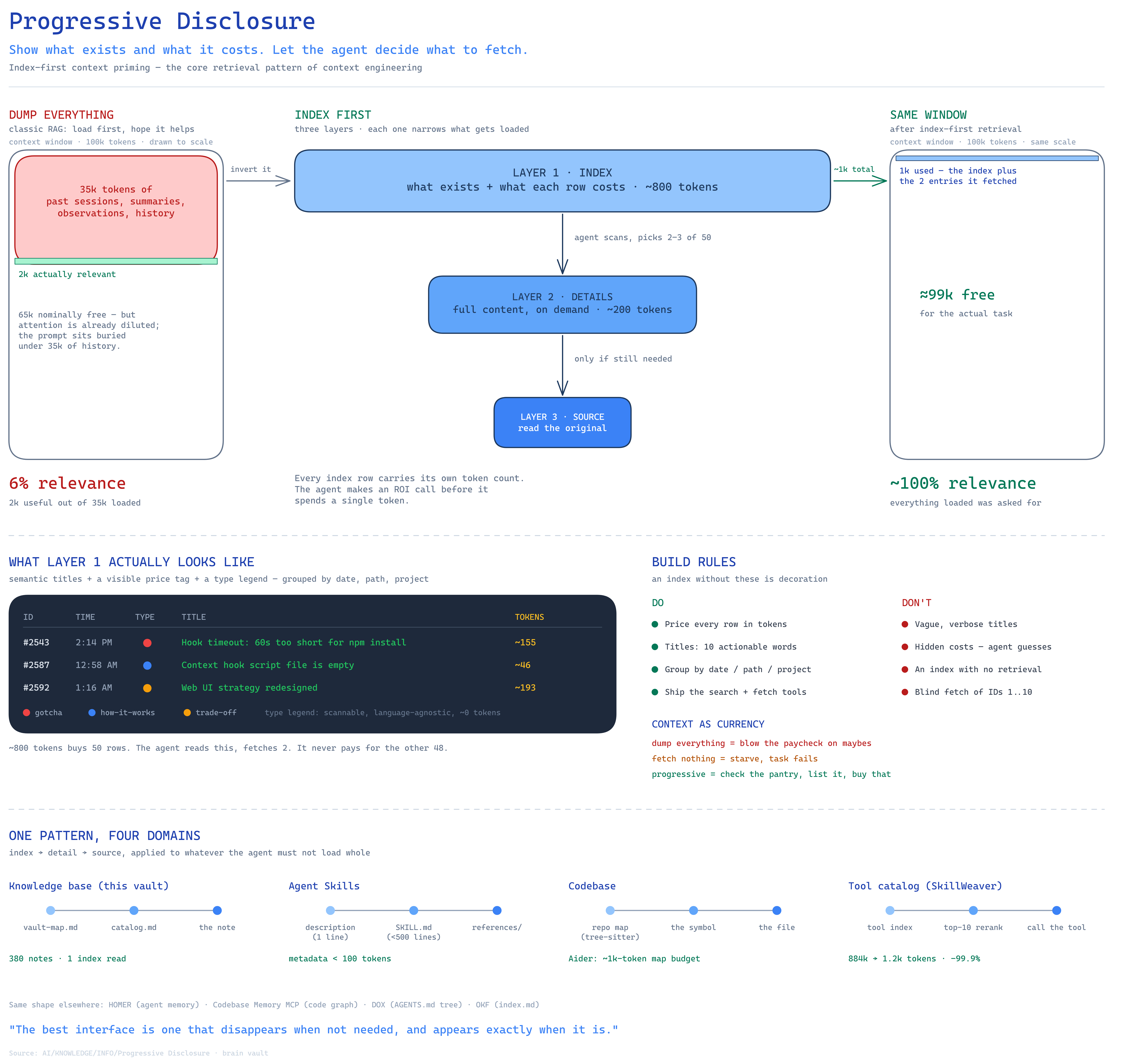
The same 100k context window drawn twice at the same scale — flooded on the left, a hairline on the right — with the three-layer funnel as the mechanism between them, a real Layer-1 index below, and the same shape applied across four domains at the bottom.
Editable source: Progressive Disclosure.excalidraw (sibling file), built with the excalidraw-diagram skill. Re-render after editing:
cd .claude/skills/excalidraw-diagram/references
uv run python render_excalidraw.py "content/AI/KNOWLEDGE/INFO/Progressive Disclosure.excalidraw"
On PLSOFT-PCD1 that uv run fails with An Application Control policy has blocked this file (os error 4551) — Smart App Control blocks the uv-managed interpreter, the same class of gotcha as in Running Browser Use on Windows via Edge CDP. Workaround: build the venv from the signed python.org install (%LOCALAPPDATA%\Programs\Python\Python313\python.exe -m venv …), pip install playwright, python -m playwright install chromium, then call render_excalidraw.py with that interpreter.
🗒️ The three layers
- Layer 1 — Index — lightweight metadata: titles, dates, types, token counts
- Layer 2 — Details — fetch full content only when relevant
- Layer 3 — Deep dive — read original source files if required
Mirrors human cognition: scan headlines before articles, TOC before chapters, filenames before opening files.
☘️ The problem: context pollution
Traditional RAG dumps everything upfront:
- 35k tokens of past sessions, observations, summaries
- Maybe 2k actually relevant — 6% efficiency
- Wastes attention budget; user prompt buried under history
Progressive disclosure inverts it:
- ~800 tokens of index → agent scans → fetches ~200 tokens on demand
- 100% relevance, 99k tokens free for the actual task
🧩 The index format
Compact tabular index showing what exists, when, type, retrieval cost:
| ID    | Time     | T  | Title                                    | Tokens |
|-------|----------|----|------------------------------------------|--------|
| #2543 | 2:14 PM  | 🔴 | Hook timeout: 60s too short for npm     | ~155   |
| #2587 | 12:58 AM | 🔵 | Context hook script file is empty       | ~46    |
| #2592 | 1:16 AM  | ⚖️ | Web UI strategy redesigned              | ~193   |
Grouped by date (temporal context), file path (spatial context), and project (logical context).
Legend system
Emoji icons signal observation type — visual scanning, language-agnostic, token-efficient:
- 🎯 session-request — user’s original goal
- 🔴 gotcha — critical edge case or pitfall
- 🟡 problem-solution — bug fix or workaround
- 🔵 how-it-works — technical explanation
- 🟢 what-changed — code/architecture change
- 🟣 discovery — learning or insight
- 🟠 why-it-exists — design rationale
- 🟤 decision — architecture decision
- ⚖️ trade-off — deliberate compromise
🎨 Mental model: context as currency
| Approach | Metaphor | Outcome |
|---|---|---|
| Dump everything | Spending whole paycheck on speculative groceries | Waste, can’t afford what’s needed |
| Fetch nothing | Refusing to spend any money | Starvation, can’t accomplish tasks |
| Progressive disclosure | Check pantry, list what’s needed, buy that | Efficiency, room for surprises |
Implementation principles
- Make costs visible — every index row shows token count so the agent makes informed ROI decisions
- Use semantic compression — good titles compress observations into ~10 actionable words. “Hook timeout: 60s too short for npm install” not “Observation about a thing”
- Group by context — date / file path / project — spatial locality reduces scanning
- Provide retrieval tools — index without
search/timeline/get_observationsis useless
The 3-layer workflow (Claude-Mem)
- Layer 1 — search —
search({ query: "hook timeout", limit: 10 })→ returns IDs (~50–100 tokens each) - Layer 2 — timeline —
timeline({ anchor: 2543, depth_before: 3, depth_after: 3 })→ narrative arc around an observation - Layer 3 — get_observations —
get_observations({ ids: [2543, 2102] })→ full details for selected IDs
Cognitive load theory
- Intrinsic load — inherent task difficulty (unavoidable)
- Extraneous load — burden of poorly-presented information. Traditional RAG adds this. Progressive disclosure minimizes it.
- Germane load — building mental models. Consistent structure (legend, grouping, semantic titles) supports it.
⚠️ Anti-patterns
- ❌ Verbose titles — “Investigation into the issue where hooks time out” vs “Hook timeout: 60s too short for npm install”
- ❌ Hiding costs — index without token counts forces the agent to guess
- ❌ No retrieval path — index with no MCP search tools is dead weight
- ❌ Skipping the index layer — fetching IDs
[1..10]blind instead of searching first
Measuring success
- ✅ Low waste ratio — relevant tokens / total context > 80%
- ✅ Selective fetching — index of 50, agent fetches 2–3
- ✅ Fast time-to-relevant — 30s with index vs 90s scanning everything
- ✅ Appropriate depth — depth scales with task complexity
📒 Key takeaways
- Show, don’t tell — index reveals what exists without forcing consumption
- Cost-conscious — visible retrieval costs enable informed decisions
- Agent autonomy — the agent knows current context better than you do
- Semantic compression — good titles make or break the system
- Consistent structure — patterns reduce cognitive load
- Two-tier everything — index first, details on-demand
- Context as currency — spend wisely on high-value information
The best interface is one that disappears when not needed, and appears exactly when it is.
🔗 Related concepts
- Context Engineering — the broader discipline; progressive disclosure is its core retrieval pattern
- Harness Engineering — wiring up retrieval tools and indexes in practice
- Agent Skills — skills are themselves a progressive-disclosure mechanism (load on demand)
- LLM Knowledge Bases — Obsidian vault here uses index-first navigation (
vault-map.md→catalog.md→ notes) - Token Optimization for Claude Code — tools that operationalize this pattern
- Graphify — knowledge-graph index over arbitrary content
- Codebase Memory MCP — the pattern applied to source code: one graph query (~3.4k tokens) replaces file-by-file grep (~412k tokens), a 99.2% cut
- Structural Retrieval for Code — the code-retrieval lanes (LSP / graph / grep) that operationalize index-first over source
- SkillWeaver — Compositional Skill Routing — the pattern applied to tool/skill selection: retrieve a shortlist per sub-task instead of loading the whole MCP library (~884k → ~1.2k tokens/query)
- Open Knowledge Format (OKF) — a knowledge-format spec whose
index.mdfiles implement this pattern - HOMER — Structured Agent Memory — same organize-then-retrieve principle applied to long-horizon agent memory
- DOX — Self-Documenting AGENTS.md — this exact pattern applied to a codebase: hierarchical AGENTS.md tree the agent navigates to the minimal edit
📖 Further reading
Claude Code Claude Code Best Practice Brain
- Cognitive Load Theory (Sweller, 1988)
- Information Foraging Theory (Pirolli & Card, 1999)
- Progressive Disclosure (Nielsen Norman Group)
Source: Claude-Mem documentation, Progressive Disclosure: Claude-Mem’s Context Priming Philosophy.
Template: knowledge_note_info