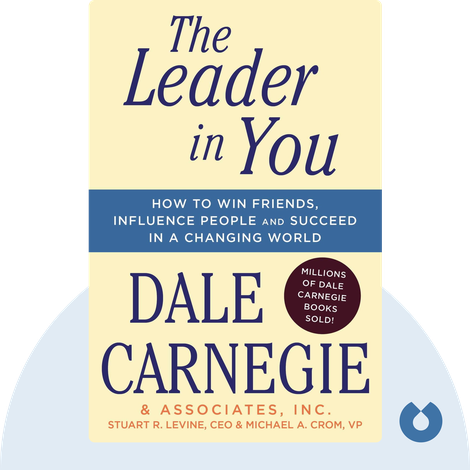
The Leader In You
Date Finished: Sep 9, 2026 Author: Dale Carnegie Tags: book leadership communication
🚀 The Book in 3 Sentences
Leadership is not a position at the top of a pyramid but a way of working with people that applies at any level, and it is built almost entirely out of communication rather than expertise. The mechanics are unglamorous and specific: listen with total attention, motivate through shared purpose rather than incentives, take other people’s perspective before arguing your own, and admit your own mistakes before criticising anyone else’s. Underneath all of it is a sustainability claim — enthusiasm and balance are not soft extras, they are what keeps the whole thing running.
🎨 Impressions
How I Discovered It
Read as a Blinkist summary in the same batch as The Art of Public Speaking, while researching talk craft for BB4IT. It landed in a different bucket: this is about the room after the talk, not the talk.
Who Should Read It?
Anyone running a small team or a two-founder company, where there is no hierarchy to hide behind and every interaction is direct. It is least useful to someone looking for a management system — there is none here, only principles — and most useful as a periodic re-read when you notice you have been optimising the work and neglecting the people doing it.
⚠️ On the 85 percent claim
The book opens with “only 15 percent of financial success comes down to expertise; the rest is personality and leadership skills”. That figure traces back to early-twentieth-century Carnegie Institute material and is repeated everywhere without a traceable methodology. Treat it as a slogan, not a statistic — the underlying point stands without it.
☘️ How the Book Changed Me
The listening chapter is the one that connects to everything else I am working on. Carnegie’s example is a radio interviewer who listens to a man describe tunnelling out of a Kremlin prison, eating dirt for months, breaking the surface inside Stalin’s office — and then asks whether he has any hobbies. The failure is comic, but the mechanism it exposes is the one I hit in Q&A: you stop listening because you are formulating. My Conference Talk Craft research reached the same conclusion from the stage side — the characteristic failure is answering the question you predicted rather than the one asked. Same defect, two contexts.
“Admit your mistakes first” is a working technique, not a virtue. The psychological hook is that being first to name your own error makes people reassure you rather than pile on, whereas assigning blame makes them defend themselves instantly. For a talk, that is directly the recovery protocol: name what went wrong, do not keep apologising, return to the thread. For a company, it is what makes it safe for anyone else to report a problem early.
Rest as a performance input rather than a reward. The US Army finding that soldiers march further and faster when they drop packs for ten minutes an hour is the honest framing — this is not self-care language, it is throughput. Given how I actually work, this is the chapter I am least likely to act on and most likely to need. Related: Dopamine Detox, Atomic habits.
Where the book is weak: it is entirely anecdote-driven, and the anecdotes are selected to confirm the principle. Mother Teresa securing furloughs, permits and funding in a single meeting, an AIDS centre open by Wednesday — it proves resolve worked once, not that resolve is the mechanism.
✍️ My Top 3 Quotes
Brilliant ideas are worthless if they’re not shared.
If you’re arguing with someone, if you’re using words like wrong and stupid, you’ve already lost.
A goal is just a dream with a deadline.
📒 Summary + Notes
Leadership is a way of working, not a rank
There is no single correct leadership personality — loud, funny, stoic, gentle and shy all work. The task is identifying which qualities are actually yours and building on those rather than importing someone else’s style.
Communication in three steps
- Make it the priority. Meetings, corridors, water-cooler moments — being busy is not an excuse.
- Be open to others. Receptiveness is reciprocated.
- Create a hospitable environment. People will not speak honestly without trust, which requires genuineness and never punishing someone for having spoken up.
Motivation comes from shared purpose
Past the point where basic needs are met, money and fear of dismissal produce half-hearted work and resentment. What produces discretionary effort is a sense of common purpose: include people in the process, ask for advice and follow it where you can, recognise people as people, praise effort, share both triumphs and failures. Treat people as capable and get out of the way.
Genuine interest, and perspective-taking
Learn names and their spellings. Note birthdays. Ask about families. Pay particular attention to people who are routinely overlooked. Then go further and take the other side’s view deliberately: what experience do they bring, what are they trying to achieve or avoid, what is unspoken but at stake. Holman halving a grower’s export price in person, standing in the field in borrowed boots, gets the deal accepted; the same news by phone does not.
Listening
The best form of both learning and persuasion, and more important than fluency or voice. Two reasons: you learn things you could not have known, and people respond to being heard. Listening is active — nod, shift posture, hold eye contact, and when they pause, ask a targeted question rather than pivoting to your own material.
Teams over hierarchies
Rigid pyramids, departmental lines and long command chains suppress creative work. The Harvard first-years forced into random teams of four for a shared grade hated it, and the groups that struggled most learned most. A good leader builds confidence, stays involved, and mentors.
Mistakes and criticism
Be first to admit your own, and never minimise their impact. Where criticism is genuinely warranted, be constructive: pair it with what is going well, or ask questions rather than issue orders so the other person can save face. The goal is to communicate, motivate and persuade — not to be shown to be right.
Goals, focus, balance, enthusiasm
Goals should be clear, measurable and attainable, both short and long term, with interim goals to compound confidence. Success needs focus, self-discipline and persistence more than talent — Burpee hired two hundred people to smell marigolds across thirty-five acres to find the odourless one. Balance is throughput, not indulgence: the Army’s ten minutes an hour, the heart’s rest between contractions, Churchill’s naps through sixteen-hour wartime days. And enthusiasm is infectious and often quiet — it can be planted and nourished rather than faked.
📖 Further reading
- The Art of Public Speaking — Carnegie on the stage rather than the room
- Conference Talk Craft — the Q&A protocol, where the listening failure recurs
- Dopamine Detox, Atomic habits — adjacent notes on attention and habit
- Blinkist source: https://www.blinkist.com/reader/books/the-leader-in-you-en-dale-carnegie
Template: book